The best wall plug in heaters for small spaces provide convenient warmth without taking up valuable floor space. They are useful for compact bedrooms, home offices, dorm rooms, and other areas where a large space heater may be impractical. However, not every plug-in heater offers the same heating power, temperature controls, or safety features.
In this guide, we cover five options, including models from Ontel, Brightown, and GiveBest, to help you compare their designs, controls, and practical uses before choosing a heater for your space.
1. Ontel Handy Heater Turbo — Best for Compact Spaces

- Compact & Powerful Plug In Heater: The Ontel Handy Heater Turbo is a small plug in space heater that fits into wall outl…
- Customizable Heating Comfort: Featuring an adjustable thermostat (60–90°F) and a programmable 12-hour timer, the Handy H…
- Quiet Operation: Designed with ceramic heating technology, auto shut off, and cool-touch housing, this outlet heater pro…
The Ontel Handy Heater Turbo is a compact electric heater designed to plug directly into a wall outlet. Its space-saving design makes it worth considering if you want supplemental warmth without placing a bulky appliance on your desk or floor.
Unlike traditional portable heaters that sit on a base, this model attaches directly to the outlet. It uses ceramic heating technology and includes temperature controls to help you adjust the warmth to your preferences.
Key Features
- Compact wall-outlet design: Plugs directly into a compatible wall outlet, helping keep floors and desks clear.
- 800-watt heating power: Provides supplemental heat for smaller indoor spaces.
- Adjustable thermostat: Allows temperature selection between 60°F and 90°F.
- Programmable timer: The timer can be set for automatic shutoff after 1–12 hours.
- Ceramic heating technology: Produces warm airflow without requiring a separate floor stand.
Best For
People who want a compact plug-in heater for a small bedroom, personal workspace, or similar indoor area. Its built-in thermostat and timer are particularly useful for adjusting heating periods without constantly monitoring the controls.
Things to Consider
- Its heating capacity is limited compared with larger space heaters, so it may not provide sufficient warmth in a poorly insulated or relatively large room.
- Check the outlet position and surrounding clearance before installation.
- The heater should be plugged directly into a suitable wall outlet rather than an extension cord or power strip.
2. Brightown Plug-In Heater with Remote — Best for Convenient Controls

- 180° Rotatable Plug: Brightown plug in heater features a unique 180° rotatable plug design to flexible installing in any…
- Energy-Efficient 450W Low Wattage: Small space heater requires 450w power to effectively heat a room up to 100 square fe…
- Upgraded Safety Protection and Remote Control: This plug in space heater safety certified with a flame-retardant housing…
The Brightown plug-in heater is designed for shoppers who want compact heating with convenient temperature adjustments. Its small form factor makes it suitable for areas where floor space is limited, while its remote control reduces the need to reach the unit whenever you want to change a setting.
The product is available in listings that describe different wattage versions, so check the specifications of the exact model before purchasing. The commonly documented MH-04 version features a ceramic heating element, an adjustable thermostat, a timer, and a rotating plug.
Key Features
- Compact design: Fits directly into a wall outlet to avoid taking up valuable floor space.
- Remote control: Allows you to adjust supported settings from a short distance.
- Adjustable thermostat: The documented MH-04 version offers temperature settings between 60°F and 90°F.
- Timer function: The documented version supports automatic shutoff with a timer of up to 12 hours.
- Rotatable plug: Helps accommodate different outlet orientations.
- Overheat protection: Provides an additional layer of protection during operation.
Best For
People who prefer a compact heater with remote operation for a small home office, dorm room, or personal living area. It may be particularly convenient when the outlet is positioned behind furniture or in a location that is difficult to reach.
Things to Consider
- Confirm the wattage and specifications of your selected version because different listings may describe different configurations.
- Remote control adds convenience, but it does not replace the need to monitor the heater and follow its safety instructions.
- Avoid using the heater in wet locations unless the specific model is expressly approved for that environment.
3. GiveBest 800W Plug-In Wall Heater — Best for Adjustable Heating

- 180° Rotating Plug & Compact Design – Perfect for Tight Spaces: This small space heater for indoor use features a unique…
- 2s Instant Heat & Smart ECO Mode – Cut Energy Bills by 40%: Experience rapid warmth in just 2 seconds with adjustable he…
- Precision Temp Control (±1℉) & Quiet Operation – Sleep Well All Night: Set your ideal temperature (60°F–90°F) with ±1°F …
The GiveBest plug-in wall heater is an option for shoppers who want a compact heater with more heating output than many lower-wattage personal heaters. Its product listing describes an 800-watt model with a digital display, adjustable thermostat, remote control, and timer.
These features make it useful for people who want greater control over their heating routine without moving a full-size heater into a small room.
Key Features
- 800-watt heating output: Provides supplemental warmth for suitable small indoor spaces.
- Adjustable thermostat: The listed model supports temperature settings from 60°F to 90°F.
- Digital display: Makes it easier to view the selected settings.
- Remote control: Allows convenient adjustment without directly touching the unit.
- Programmable timer: Supports scheduled automatic shutoff.
- Compact plug-in format: Helps preserve floor space in smaller rooms.
Best For
People looking for a wall-outlet heater with adjustable temperature settings and remote operation. It may suit a compact home office, bedroom, or other indoor space where convenient controls are a priority.
Things to Consider
- An 800-watt heater is intended for supplemental heating and may struggle to maintain a comfortable temperature in a large or poorly insulated room.
- Check the exact model number, timer functions, and safety information on the current product listing.
- Although the listing mentions bathroom use, do not assume the heater is safe for installation near water. Follow the manufacturer’s specific instructions and applicable electrical safety requirements.
4. G-WILL Portable Electric Heater — Best to Consider for Everyday Supplemental Warmth
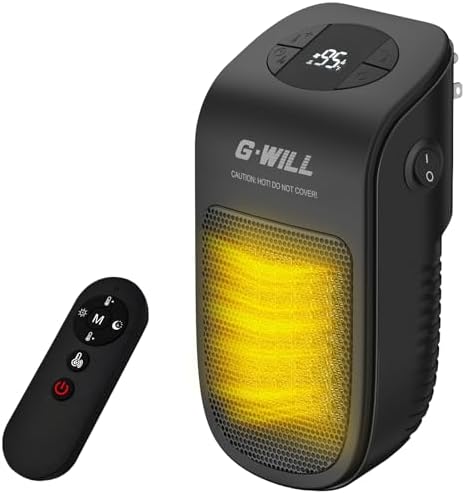
- 🔋 [Unbelievably Energy Saving] Averaging only 2.57 cents per hour to run – verified by US customers. Save $150~$300 on e…
- ⏰ [Exclusive Wake-up Timer — Never Wake to a Cold Room Again] Set the heater to quietly pre-warm your room to cozy duvet…
- 🎚️ [5 Smart Modes for Every Need] 1) CL (1~5W): Cool breeze only, no heating. 2) LL (180~320W): Ultra-quiet low power fo…
The G-WILL portable electric heater is another option to investigate when comparing compact heating products for smaller indoor spaces. Its supplied product listing identifies it as a portable electric heater with thermostat-related features.
Before choosing this model, pay particular attention to its current product specifications. Details such as wattage, temperature range, heating technology, and plug configuration should be verified against the exact version being sold.
Key Features
- Portable electric heating: Offers an alternative to larger floor-standing heaters.
- Thermostat-related controls: Check the listing to confirm the available temperature adjustments and control functions.
- Compact-space potential: Consider its physical dimensions and outlet arrangement to determine whether it suits your intended location.
- Model-specific operation: Review the supplied manual for instructions on operating the heater and managing its heating settings.
Best For
Shoppers comparing less familiar plug-in heater brands who want to evaluate the available controls, dimensions, and heating output before making a decision.
Things to Consider
- Confirm the wattage before comparing this heater with the 800-watt Ontel and GiveBest models.
- Verify whether the unit plugs directly into a wall outlet or uses a different configuration.
- Check for documented overheat protection and appropriate electrical safety certification rather than assuming these features are included.
- Review the manufacturer’s recommended room size and installation instructions before use.
5. Adjustable Electric Plug-In Heater — Best for Comparing Basic Heating Features

- FAST 3-SECOND CERAMIC HEATING: Built with a PTC ceramic heating element, this 450W wall outlet heater releases warm air …
- REMOTE CONTROL + 12H TIMER + LED DISPLAY: Adjust heat modes, set the 1-12 hour auto-off timer, and read the current temp…
- 2 MODES – NATURAL WIND & WARM AIR: One setting blows natural wind for air circulation, the other gives warm air for ins…
The fifth option is an adjustable electric heater whose supplied listing highlights an adjustable thermostat and overheat protection. These are important features to investigate when choosing a compact heater for a small room.
An adjustable thermostat can help you select a preferred temperature, while overheat protection is designed to stop operation when the heater reaches an unsafe internal temperature. However, the exact implementation and additional features depend on the specific model.
Key Features
- Adjustable temperature control: Check the current listing for the available temperature range and adjustment method.
- Overheat protection: The supplied product title identifies this as a feature.
- Electric heating: Provides an alternative to gas-powered or fuel-burning heaters.
- Compact-heater category: Compare its dimensions and plug design to determine whether it fits your available space.
Best For
Shoppers who want to compare a basic adjustable electric heater with more established options before deciding which model best meets their requirements.
Things to Consider
- Verify the product’s wattage, temperature range, and physical dimensions before purchasing.
- Confirm whether a remote control, timer, digital display, or rotating plug is actually included.
- Look for recognized electrical safety certification and read the manufacturer’s instructions carefully.
- Do not use the heater in a bathroom or another damp environment unless its specific safety rating and instructions permit it.
How to Choose the Right Wall Plug-In Heater for Small Spaces
Choosing the right plug-in heater involves more than comparing prices. Consider the size of your room, the amount of supplemental warmth you need, the available outlet, and the safety features of the specific model.
1. Match Heating Power to Your Space
Wattage is an important factor when comparing electric heaters.
Lower-wattage models generally provide less heat output, making them more appropriate for localized warmth or mild conditions. An 800-watt heater produces more heat than a 450-watt model when both operate at their rated output, but that does not guarantee it will heat every small room adequately.
Room insulation, outdoor temperatures, ceiling height, drafts, and existing heating all influence performance.
For a small office or personal workspace, a lower-wattage model may be sufficient. If you need more supplemental warmth, consider a higher-output option that is suitable for your room and electrical circuit.
2. Look for an Adjustable Thermostat
A thermostat lets you select a target temperature rather than relying solely on a basic on/off switch.
This can make a heater easier to use as room conditions change. Some models display the selected temperature digitally, while others use simpler controls.
Check whether the temperature range meets your needs and whether the heater automatically cycles to maintain the selected setting.
3. Consider a Timer and Remote Control
A timer can automatically switch off the heater after a selected period. This is useful when you need temporary warmth while working or spending time in a room.
A remote control can make adjustments more convenient, especially if the heater is positioned at an awkward height.
However, a timer should not be treated as a substitute for safe operation or as permission to leave a heater running unattended or while sleeping contrary to the manufacturer’s instructions.
4. Check the Plug Design and Available Space
One of the main advantages of wall plug-in heaters is that they do not require a separate floor stand.
Before buying, measure the available space around your outlet. Check whether the heater will block neighboring outlets, interfere with plugs, or sit too close to curtains, furniture, bedding, or other combustible materials.
A rotating plug may help with outlet orientation, but it does not eliminate the need for adequate clearance.
5. Prioritize Safety Features
Electric heaters should be selected with safety in mind, particularly when used in bedrooms or other compact spaces.
Look for documented overheat protection, appropriate electrical safety certification, and clear operating instructions. Follow the manufacturer’s specified clearance distances and keep air intake and exhaust openings unobstructed.
Plug the heater directly into a suitable wall outlet. Do not use an extension cord, power strip, or multi-outlet adapter unless the manufacturer and applicable safety requirements explicitly permit the configuration.
Never cover the heater or place it close to bedding, curtains, or furniture. Keep it away from water, and do not assume that a product advertised for bathroom use is safe for every bathroom location.
6. Compare Energy Use and Running Costs
A plug-in heater’s electricity consumption depends on its wattage and how long it operates.
For example, an 800-watt heater running continuously for one hour consumes 0.8 kilowatt-hours of electricity. A 450-watt heater running for the same period consumes 0.45 kilowatt-hours.
Actual consumption may be lower if a thermostat cycles the heater off, but this depends on room conditions and the selected temperature.
To estimate running costs, multiply the electricity consumed in kilowatt-hours by your electricity rate. Remember that a lower-wattage heater may cost less to operate but can also provide less heat.
7. Check the Exact Model and Warranty
Product listings can change, and similar-looking heaters may have different specifications.
Before purchasing, verify the model number, wattage, thermostat range, timer, safety features, and included accessories. Read the manufacturer’s warranty terms and check whether replacement or customer support is available.
This is especially important for less familiar brands or listings that do not clearly identify the product’s specifications.
FAQs:
1. Are wall plug-in heaters good for small rooms?
Wall plug-in heaters can be useful for supplemental warmth in compact spaces because they do not require a floor stand. Their effectiveness depends on wattage, insulation, room size, and the surrounding temperature. They may not provide enough heat to serve as the primary heating source in every room.
2. What is the difference between a 450-watt and an 800-watt plug-in heater?
An 800-watt heater produces more heat at its rated output than a 450-watt heater. It also consumes more electricity per hour when operating continuously at full power. The better choice depends on how much supplemental heat your space requires.
3. Are wall plug-in heaters expensive to run?
Their running costs depend on wattage, operating time, thermostat settings, and your electricity rate. For example, an 800-watt heater running continuously for five hours consumes 4 kWh. Multiply that figure by your electricity price to estimate the cost.
4. Can you leave a plug-in heater on overnight?
Do not assume that a compact size, thermostat, or automatic shutoff makes a heater suitable for overnight operation. Follow the manufacturer’s instructions and applicable fire-safety guidance. Keep the heater away from bedding and combustible materials, and never cover it or obstruct its airflow.
5. Can wall plug-in heaters be used in bathrooms?
Only use a heater in a bathroom if its specific design, electrical protection, and manufacturer’s instructions permit that environment. Water and electricity create serious hazards, and a product listing that mentions bathroom use does not automatically establish that it is safe near sinks, showers, or bathtubs.
Conclusion:
The best wall plug-in heaters for small spaces combine a compact design with suitable heating output, convenient temperature controls, and clearly documented safety features. The Ontel Handy Heater Turbo is worth considering if you want an 800-watt model with a thermostat and timer. Brightown offers a compact option with remote control, while the GiveBest model provides another higher-output alternative. The remaining two products deserve closer specification checks before you decide.
Before buying, compare the exact model, wattage, timer, thermostat, and safety certification. Choose a heater that fits your space and intended use, and always follow the manufacturer’s operating and clearance instructions.