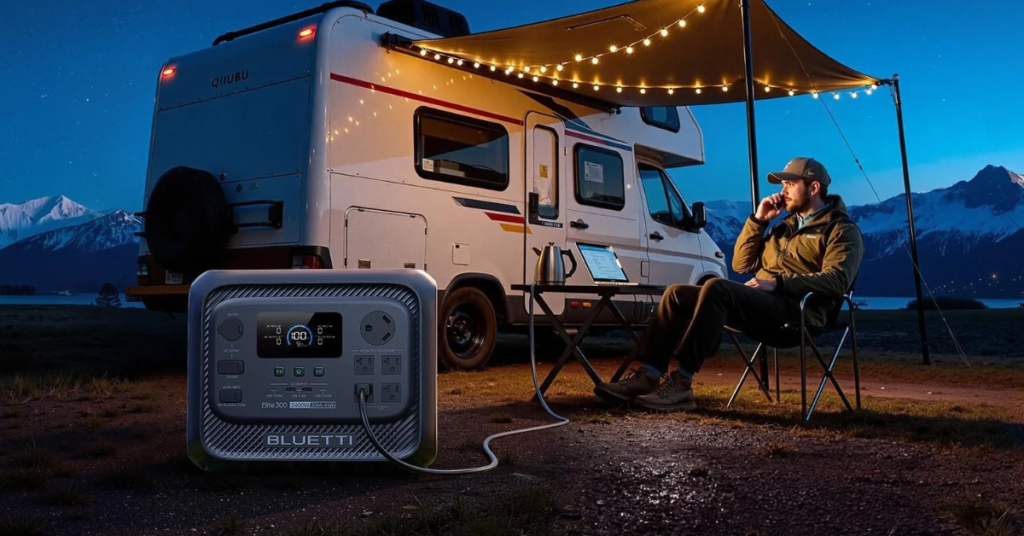
Winter storms can bring power outages, freezing temperatures, and unexpected disruptions to everyday life. The best portable power stations for winter emergencies can help keep essential devices running, provide backup electricity for selected appliances, and make emergency preparations easier.
However, not every power station can handle the same workload. Battery capacity, output power, recharge options, and performance in cold temperatures all matter when choosing a reliable backup. This guide covers five portable power stations from Jackery, BLUETTI, and EcoFlow, explaining their key features, suitable uses, and important limitations to consider before buying.
1. Jackery HomePower 3600 Plus — Best for Extended Home Backup
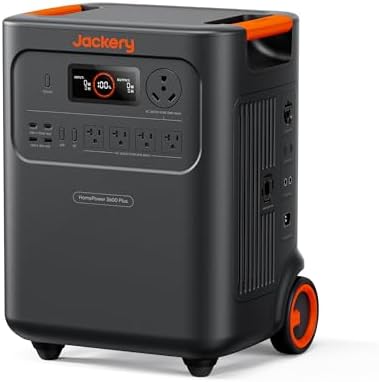
- Essential Home Backup: The Jackery HomePower 3600 Plus delivers 3600W output (7200W in parallel) to run pumps, heaters, …
- Safe Power That Lasts: Built with high-temp resistant ceramic membrane battery cells tested at 302 °F, the Jackery HomeP…
- Plug-and-Play: With its easy plug-and-play design, the Jackery HomePower 3600 Plus, paired with MTS, powers your home ef…
The Jackery HomePower 3600 Plus is designed for households that need more than a small battery for phones and laptops during winter power outages. Its high capacity and substantial AC output make it a candidate for running several essential devices, provided their combined power requirements remain within the unit’s limits.
This model is particularly relevant when preparing for longer outages, as it supports additional battery packs and compatible solar charging equipment. However, its size and weight make it less convenient to move around than smaller portable power stations.
Key Features
- 3,584Wh battery capacity: Stores a substantial amount of energy for selected household essentials.
- 3,600W rated AC output: Can power compatible appliances whose running and starting requirements fall within its limits.
- Expandable capacity: Supports additional battery packs, with a maximum stated system capacity of 21.5kWh.
- LiFePO₄ battery chemistry: Uses lithium iron phosphate cells, with a manufacturer-rated life of 6,000 cycles to at least 70% capacity.
- Solar charging support: Accepts compatible solar input, allowing you to recharge when suitable sunlight is available.
Best For
Homeowners preparing for extended winter outages who need backup electricity for multiple essential devices and want the option to expand their storage capacity.
Things to Consider
- At approximately 35kg (77lb), this unit is heavy for one person to carry regularly.
- Space heaters and other high-power appliances can drain even a large battery quickly.
- The unit is not waterproof, so keep it protected from snow, rain, and moisture.
- Charging is permitted only within the specified temperature range. Plan to keep the unit in a suitable environment during cold weather.
2. BLUETTI Elite 300 — Best for High-Capacity Backup in a Compact Form
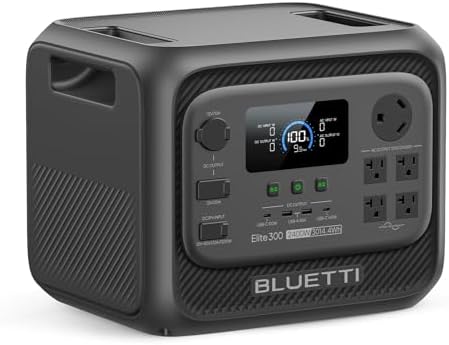
- [Compact 3kWh Power — Verified by Frost & Sullivan] – Elite 300 packs a full 3014Wh capacity into an ultra-compact desig…
- [RV-Ready with TT-30 Port & 12V/30A DC Output] – Designed for RV power systems, Elite 300 includes a TT-30 RV outlet and…
- [Reliable Home Backup Power for Outages] – Be prepared for unexpected power outages. With 3014Wh capacity and 2400W outp…
The BLUETTI Elite 300 is designed for users who want substantial battery capacity without moving to a much larger home backup system. Its 3,014.4Wh battery provides a considerable energy reserve for selected household essentials during a winter outage.
For emergency preparation, this combination of capacity and multiple output options can be useful for powering electronics, lighting, communication devices, and compatible appliances. It is also worth considering if you want a rechargeable power station that can be replenished before a storm or through compatible solar equipment.
Key Features
- 3,014.4Wh battery capacity: Provides a large reserve for essential devices and selected appliances.
- 2,400W maximum AC output: Supports compatible appliances within the unit’s output limits.
- LiFePO₄ battery: Uses lithium iron phosphate battery chemistry.
- Multiple charging options: Supports AC charging and DC input, including compatible solar charging equipment.
- USB-C power delivery: Includes 100W and 140W USB-C outputs for compatible laptops and other devices.
- UPS functionality: Offers a 10ms switchover time for suitable connected equipment.
Best For
Households that need substantial backup capacity for electronics and selected appliances but want a unit that is more manageable than a large expandable home power system.
Things to Consider
- The unit weighs approximately 26.3kg (58lb), so it is not lightweight.
- Its specified charging temperature begins at 0°C (32°F). Do not attempt to recharge it below the manufacturer’s permitted temperature.
- Its 2,400W output does not mean it can run every household appliance; check the appliance’s starting and running wattage.
- Solar recharging depends on sunlight, panel capacity, and weather conditions, which can be limiting during winter storms.
3. Jackery Explorer 2000 v2 — Best for Portable High-Capacity Power

- High-Capacity Power Solution: With 3 AC ports delivering a total output of 2200W and a massive 2042Wh capacity, the Jack…
- Smallest & Lightest 2kWh Power: Weighing just 39.5 lbs, the Jackery Explorer 2000 v2 weighs less than other bulky units,…
- Ultra-Fast & Versatile Charging: Power up and go — Charge the Explorer 2000 v2 from 0 to 80% in just 66 minutes with AC …
The Jackery Explorer 2000 v2 is a useful option for shoppers who need a substantial battery reserve but do not necessarily require a full home backup system. Its capacity and output make it suitable for a range of electronics and selected household appliances during an outage.
Unlike small emergency power banks, this class of power station can support larger loads, depending on their wattage and how long they need to run. It is important, however, to distinguish stored energy from output power: battery capacity determines how much energy is available, while the wattage rating determines which devices can operate.
Key Features
- Large battery reserve: The Explorer 2000 v2 is commonly specified at approximately 2,042Wh.
- High AC output: The model is rated for up to 2,200W of AC output, allowing it to support compatible higher-demand devices.
- Portable power format: Provides a self-contained battery and inverter rather than requiring fuel during use.
- Rechargeable design: Can be recharged before an outage and used again after power is restored; check the exact package for included charging accessories and supported solar configurations.
Best For
People who want a substantial amount of stored energy for emergency electronics, lighting, communication equipment, and selected appliances without choosing the largest home backup unit.
Things to Consider
- A capacity of around 2kWh can be depleted quickly by high-wattage appliances.
- Confirm the exact model and current specifications on the supplied product listing, as Jackery sells several Explorer models with different capacities and outputs.
- Do not assume that a power station can run a furnace, boiler, refrigerator, or other essential appliance without checking its power requirements and connection method.
- Follow the manufacturer’s cold-weather charging and operating limits.
4. EcoFlow DELTA 3 — Best for Fast Recharging and Everyday Essentials

- Full Charge in 56 Min. With DELTA3’s upgraded technology combining 500W solar input and 1500W max AC input, a full charg…
- Flexible Expansion up to 5kWh. The DELTA 3 Series integrates with EcoFlow’s ecosystem, allowing expansion up to 5kWh wit…
- Durable and Reliable for 10 Years. Powered by LiFePO4 (LFP) cells, with 4000 cycles to 80%, offering 25% more durability…
The EcoFlow DELTA 3 is a practical choice for shoppers who want a portable power station that can be recharged relatively quickly between outages. Its 1,024Wh battery is smaller than those of the first three models, but it offers a useful balance of capacity, output, and portability.
This unit is better suited to powering selected essential devices than to supplying a whole household with electricity for an extended period. Its fast AC charging capability can be particularly helpful when power returns for only a limited time before another outage.
Key Features
- 1,024Wh battery capacity: Suitable for selected electronics, lights, routers, and other compatible devices.
- 1,800W AC output: Can run appliances within its rated output limits, with a higher surge rating for compatible startup loads.
- LiFePO₄ battery chemistry: Designed for repeated charging and discharging, with a manufacturer-rated cycle life of 4,000 cycles to at least 80% capacity.
- Fast AC charging: The manufacturer specifies a charging time of approximately 56 minutes under supported conditions for the original US model.
- Multiple output options: Includes AC outlets, USB-A, USB-C, and 12V DC output options for different devices.
- UPS functionality: Provides a switchover time of less than 10 milliseconds for suitable connected equipment.
Best For
People who want a relatively portable backup battery for electronics, communications, lighting, and occasional use of compatible household appliances.
Things to Consider
- Its 1,024Wh capacity is substantially smaller than the capacities of the Jackery HomePower 3600 Plus and BLUETTI Elite 300.
- High-power appliances can consume its stored energy quickly.
- The original DELTA 3’s specified charging range begins at 0°C (32°F), while its discharge range extends to -10°C (14°F). Keep charging and operating temperatures separate when planning for cold weather.
- Check the exact regional version, since output voltage, charging specifications, and supported features may vary.
5. Jackery Explorer 300 — Best for Lightweight Emergency Essentials

- Ultra-Lightweight: At only 7.5 lbs, the Explorer 300 delivers a robust 292Wh capacity while remaining 17% lighter than t…
- Versatile Power for 6 Devices: Equipped with 2 AC outlets, a 100W USB-C PD port, 2 USB-A ports, and a 120W car port. Wit…
- Built to Last: Upgraded with premium LiFePO4 chemistry, this portable generator delivers over 4,000 charge cycles before…
The Jackery Explorer 300 is a small power station for people who prioritize portability over long backup runtimes. With a commonly listed capacity of 293Wh and 300W rated AC output, it is designed for smaller devices rather than demanding household appliances.
For winter emergencies, a compact unit can be useful for keeping phones charged, powering LED lights, and supplying electricity to selected low-power electronics. It can also serve as a secondary power source if you already have a larger battery system.
Key Features
- 293Wh battery capacity: Stores enough energy for selected low-power devices and short-duration use.
- 300W rated AC output: Suitable for compatible electronics that stay within its power limit.
- Multiple output types: Includes AC outlets, USB-A, USB-C, and a 12V car output.
- Solar charging compatibility: Supports charging with a compatible Jackery SolarSaga panel.
- Portable construction: Its relatively small size makes it easier to carry and store than the larger units in this guide.
Best For
People who need a lightweight backup for phones, small lights, laptops with compatible power requirements, and other low-power electronics.
Things to Consider
- Its capacity is much smaller than the other four options, so it is better for short-duration emergency use.
- A 300W output rating rules out many space heaters, kettles, microwaves, and other high-power appliances.
- The original Explorer 300 uses a lithium-ion battery, so check its temperature limits carefully. The listed charging range begins at 0°C (32°F).
- A solar panel may be sold separately, depending on the package.
How to Choose the Right Portable Power Station for Winter Emergencies
Choosing a winter backup power station involves more than finding the biggest battery. Consider which devices you need to keep running, how long an outage might last, and whether you can recharge the unit during an emergency.
1. Battery Capacity and Runtime
Battery capacity is measured in watt-hours (Wh). A higher number generally means more stored energy, although actual runtime depends on inverter losses and the power consumed by connected devices.
For example, a device drawing 50W for 10 hours uses 500Wh. A power station with 1,000Wh of capacity may therefore be suitable for that load under favorable conditions, but actual runtime will be shorter than a simple calculation suggests.
- Around 300Wh: Best for phones, lights, and smaller electronics.
- Around 1,000Wh: A practical starting point for multiple essential devices.
- Around 2,000–3,000Wh: More suitable for longer use or a wider selection of compatible appliances.
- 3,000Wh or more: Worth considering for larger emergency energy needs and potential capacity expansion.
These are general planning categories, not guaranteed runtimes.
2. Output Wattage and Appliance Compatibility
Watt-hours tell you how much energy is stored, while watts indicate how much power the unit can deliver at a given moment.
Check both the running wattage and startup surge of appliances such as refrigerators, pumps, and some heating equipment. If several devices will operate simultaneously, add their power requirements together.
Do not assume a portable power station can run an electric space heater for an entire night. A 1,500W heater consumes approximately 1.5kWh per hour of operation at full power, before accounting for conversion losses.
3. Cold-Weather Charging and Operation
Cold weather is especially important when selecting an emergency battery. Some power stations can discharge at temperatures below freezing but cannot safely recharge at those same temperatures.
Before buying, check the manufacturer’s separate temperature limits for charging, discharging, and storage. If the battery is too cold to charge, move it to a suitable temperature-controlled environment and follow the manufacturer’s instructions.
Never bypass a battery’s low-temperature protection.
4. Recharge Options
A useful emergency power station should have a recharge plan as well as enough initial capacity.
- AC charging: Useful when household electricity is available.
- Solar charging: Can help replenish the battery during daylight, although winter cloud cover and short days can reduce output.
- Car charging: May be useful during travel or when other charging options are unavailable, provided the model supports it.
Check whether solar panels and additional charging accessories are included or sold separately.
5. Portability and Expandability
A smaller power station is easier to carry between rooms or transport in a vehicle. Larger models offer more stored energy but may weigh 25–35kg or more.
If you want to expand your backup capacity later, verify which additional batteries the specific model supports. Battery packs from different models are not necessarily interchangeable.
6. Emergency Safety and Preparation
A portable power station is a backup electricity source, not a complete winter survival system. Keep phones charged, maintain flashlights and warm clothing, and have a plan for safe heating if the power goes out.
Never operate a fuel-burning generator indoors or in an enclosed garage. Never use a portable power station as an improvised connection to household wiring. Any home integration should use approved equipment installed by a qualified electrician.
FAQs:
1. What size portable power station is best for winter emergencies?
For phones, lights, and smaller electronics, a unit around 300Wh may be enough. For several essential devices or longer outages, consider approximately 1,000–3,000Wh or more, depending on your expected power use.
2. Can a portable power station run a space heater?
Some larger models may support a compatible space heater’s wattage, but runtime is the main limitation. A 1,500W heater can use 1,500Wh in one hour at full power. Check the power station’s rated output and available energy before connecting any heater.
3. Can portable power stations be charged in freezing temperatures?
Not all models can be charged below freezing. Some allow cold-weather discharge but require temperatures above 0°C (32°F) for charging. Always follow the exact model’s specified temperature limits.
4. Are solar generators useful during winter power outages?
Yes, if the system supports solar charging and there is enough available sunlight. However, cloudy weather, snow cover, short daylight hours, and panel positioning can reduce energy production. Keep another charging option available when possible.
5. How long can a portable power station power a refrigerator?
Runtime depends on the refrigerator’s energy consumption, startup surge, ambient temperature, and the usable energy in the battery. Check the refrigerator’s energy label or measure its actual consumption, then compare it with the power station’s capacity. Avoid relying on an estimated runtime without allowing for conversion losses and compressor cycling.
Conclusion:
The best portable power stations for winter emergencies depend on the size of your backup needs. The Jackery HomePower 3600 Plus and BLUETTI Elite 300 offer substantial stored energy for selected household essentials. The Jackery Explorer 2000 v2 provides another high-capacity option, while the EcoFlow DELTA 3 balances capacity with relatively fast recharging. The compact Jackery Explorer 300 is better suited to phones, lights, and smaller electronics.
Before choosing, prioritize battery capacity, output wattage, cold-weather limits, and recharge options. A properly sized power station, combined with a realistic emergency plan, can help you stay connected and keep essential devices running when winter weather disrupts electricity.