Finding the best quiet space heaters for bedroom sleeping means balancing low operating noise, consistent warmth, temperature control, and safety features. A noisy heater can disturb your rest, while a model without a reliable thermostat may make your bedroom uncomfortable.
Ceramic space heaters are popular for their quick heating and compact designs, with features such as oscillation, remote controls, and automatic shutoff adding convenience. In this guide, we compare five space heaters, including models from Dreo and Lasko, to help you understand their features, differences, and important considerations before choosing one for your bedroom.
1. Dreo Portable Ceramic Space Heater — Best for Quiet Bedroom Heating

- Powerful heat that fits everywhere: DREO space heaters for indoor combines Hyperamics 1500W advanced PTC system with a n…
- Unbreakable safety: DREO goes beyond the unexpected to deliver peace of mind with every room heater. The innovative tilt…
- Ultimate temperature control: The enhanced NTC chipset brings more precision to turn your space heater with thermostat i…
Dreo portable ceramic space heaters are designed to provide quick warmth in bedrooms, home offices, and other indoor spaces. The model in this listing combines ceramic heating technology with temperature controls intended to make everyday heating more convenient.
For bedroom use, the most important considerations are operating noise, temperature adjustment, and the ability to control the heater without repeatedly getting out of bed. This Dreo model is worth considering if you want a compact electric heater with several convenient features.
Key Features
- Ceramic heating technology: Provides quick heat without requiring a large, permanently installed heating system.
- Adjustable thermostat: Helps maintain a preferred temperature instead of relying entirely on manual on-and-off operation.
- Portable design: Makes it easier to move the heater between suitable indoor locations when it is switched off and cool.
- Convenient operation: Check the specific listing for the available heat settings, timer, and remote-control functions.
Best For
People looking for a compact ceramic space heater with temperature control for a bedroom, home office, or other small indoor area.
Things to Consider
- A fan-based ceramic heater produces some airflow noise, even when advertised as quiet.
- Actual heating performance depends on bedroom size, insulation, ceiling height, and outdoor temperature.
- Keep the heater away from bedding, curtains, and furniture. Do not operate a portable space heater while sleeping.
2. Dreo 70° Oscillating Space Heater — Best for Spreading Warmth Around the Bedroom

- Powerful and Efficient Heating: This DREO Heater 319 space heater for indoor use utilizes a Hyperamics 1500W advanced PT…
- Cozy Tranquility: DREO’s heater for bedroom provides whisper-quiet operation, thanks to its brushless DC motor and wingl…
- Comprehensive Safety: The electric heater is built with a child-lock, tip-over protection, V0 flame retardant material, …
A heater that directs warm air across a wider area can be useful when one part of the bedroom feels colder than another. This Dreo model features 70-degree oscillation, which moves the airflow from side to side instead of directing all the heat toward a single spot.
Its combination of ceramic heating, adjustable temperature settings, and oscillation makes it worth considering for people who want more flexible heat distribution.
Key Features
- 70-degree oscillation: Moves warm airflow across a wider section of the room.
- PTC ceramic heating: Designed to provide quick warmth when the heater is switched on.
- Multiple operating modes: The listed product documentation describes different heating modes to accommodate changing comfort needs.
- Timer and temperature controls: These features can make it easier to manage heating periods and maintain a preferred room temperature.
Best For
People who want a portable heater that distributes warmth across different parts of a bedroom rather than continuously blowing air in one direction.
Things to Consider
- Oscillation distributes airflow but does not guarantee that every corner of a large bedroom will reach the same temperature.
- The fan remains a potential source of noise, so consider the manufacturer’s noise rating and the available low-heat setting.
- Confirm the exact model’s thermostat range, timer duration, and remote-control features before purchasing.
3. Lasko 751320 Ceramic Space Heater — Best for Convenient Temperature Control

- POWERFUL ELECTRIC SPACE HEATER: Trade the extra layers for real warmth. 1500W of quiet ceramic heat and wide oscillation…
- ETL CERTIFIED: Relax while it runs. A self-regulating ceramic element, overheat protection, and cool-touch housing make …
- CUSTOMIZE YOUR COMFORT: The remote control handles heat settings, oscillation, and a timer—no need to leave the couch or…
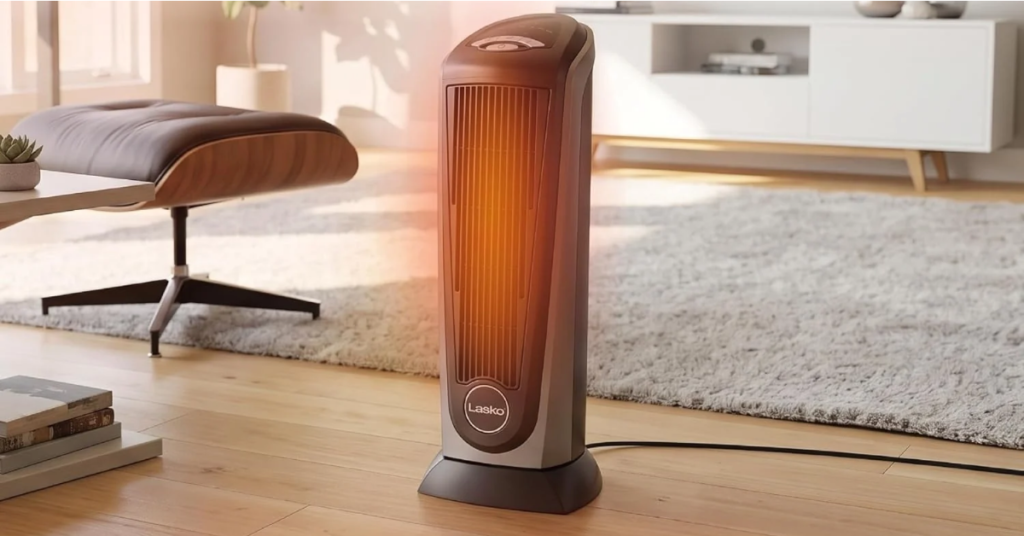
The Lasko 751320 Ceramic Space Heater is a tower-style ceramic heater designed to provide supplemental warmth indoors. Its taller design distinguishes it from compact heaters that sit close to the floor or on a desk.
This model is worth considering if you prefer a traditional tower heater with electronic controls and oscillation. Its combination of temperature adjustment and programmable operation can be useful when you want to warm a bedroom before settling down for the evening.
Key Features
- Ceramic heating: Provides supplemental warmth for indoor spaces.
- Oscillation: Helps move warm air across a broader area instead of concentrating it in one direction.
- Electronic controls: Allow users to adjust heating operation more conveniently than basic manual controls.
- Remote and timer functions: The model is associated with convenient control features, although you should confirm the specifications of the exact listing before buying.
Best For
People who prefer a tower-style heater and want convenient controls for warming a bedroom or another indoor living space.
Things to Consider
- Tower heaters generally require more floor space than small personal heaters.
- Oscillation and fan operation can create audible noise, which may matter to people who are sensitive to sound while sleeping.
- Check the exact model’s dimensions and controls to ensure they match your available space and preferences.
4. Compact Portable Electric Space Heater — Best for Simple Supplemental Heating

- 【2S INSTANT SPACE HEATER FOR INDOOR USE】 Advanced PTC ceramic heating technology rapidly warms personal spaces up to 200…
- 【QUIET INDOOR SPACE HEATER】 Near-silent 40dB operation ensures zero disturbance. Fire-resistant casing provides 360° pro…
- 【SAFETY PROTECTION FUNCTIONS ENSURE SAFE USE】 Small heater for indoor use quipped with a safety switch, auto shut-off ac…
The fourth product is listed as a compact portable indoor space heater. Because the available product information does not establish its exact manufacturer, model, noise rating, and full specifications, it is important to evaluate the current listing carefully.
A compact heater can be practical when you want supplemental warmth in a small room without purchasing a larger heating appliance. However, a small size alone does not guarantee quiet operation, good temperature regulation, or suitable safety features.
Key Features
- Portable format: A compact design can be convenient when floor space is limited.
- Indoor heating: Intended for supplemental warmth in an indoor environment, subject to the manufacturer’s instructions.
- Space-saving design: May be suitable for rooms where a larger tower heater would be inconvenient.
- Potentially simple operation: Check the listing to determine whether it includes adjustable heat settings, a thermostat, or a timer.
Best For
Shoppers considering an affordable, compact space heater who are prepared to verify its specifications and safety credentials before purchasing.
Things to Consider
- Do not assume that this model is quieter than the Dreo or Lasko options without a reliable noise specification.
- Confirm that it has appropriate tip-over and overheat protection.
- Verify the manufacturer’s identity, electrical specifications, certification, warranty, and operating instructions.
- Avoid purchasing solely on the basis of a low price or claims such as silent operation.
5. Dreo 360° Omni-Directional Space Heater — Best for Wider Heat Distribution

- 𝟯𝟲𝟬° 𝙒𝙝𝙤𝙡𝙚-𝙍𝙤𝙤𝙢 𝙒𝙖𝙧𝙢𝙩𝙝: Distributes warm air quickly throughout the room thanks to its 360 circular air outlet with 9.5 …
- 𝙁𝙖𝙨𝙩 𝙒𝙖𝙧𝙢𝙩𝙝 𝙞𝙣 𝙅𝙪𝙨𝙩 𝟮 𝙎𝙚𝙘𝙤𝙣𝙙𝙨: Powered by a 1500W PTC ceramic heating system, this whole room heater delivers warm air i…
- 𝟴-𝙇𝙖𝙮𝙚𝙧 𝙎𝙖𝙛𝙚𝙩𝙮 𝙋𝙧?𝙩𝙚𝙘𝙩𝙞𝙤𝙣: Equipped with safety features for maximum protection, including overheat, flame-retardant mat…
The Dreo 360-degree omni-directional space heater is designed around a different heating approach from conventional heaters that direct warm air primarily forward. Its product name indicates an emphasis on distributing warmth around the heater rather than focusing exclusively on one direction.
This design may be useful when you want to distribute supplemental warmth across a shared area. For bedroom use, however, its noise level, temperature controls, and placement requirements remain just as important as its airflow design.
Key Features
- 360-degree heating design: Intended to distribute warmth around the heater rather than concentrating it in a single direction.
- Adjustable thermostat: Check the current listing for the available temperature range and adjustment increments.
- Overheat protection: The supplied product title identifies overheating protection as a feature.
- Portable electric design: Can be used as supplemental indoor heating when installed and operated according to the manufacturer’s instructions.
Best For
People who want to compare a multi-directional heater with conventional ceramic models and need supplemental warmth across a broader area.
Things to Consider
- A 360-degree heating design does not necessarily mean the heater will warm an entire bedroom evenly.
- Confirm its noise rating at the lowest heat setting if quiet operation is a priority.
- Check the exact model’s timer, thermostat, tip-over protection, and electrical requirements.
- Do not leave the heater operating unattended while sleeping, even if it includes automatic safety features.
How to Choose the Right Quiet Space Heater for Bedroom Sleeping
Choosing a quiet bedroom heater involves more than comparing product names or advertised wattage. Focus on the features that affect comfort, noise, and safe operation.
1. Check the Operating Noise
Noise is one of the most important considerations for people who are sensitive to sound at night.
Ceramic space heaters typically use a fan to distribute warm air. This can produce a steady humming or airflow sound, even when the manufacturer describes the unit as quiet.
When comparing models, look for a published noise rating in decibels (dB). Check whether the rating applies to the lowest setting or a different operating mode. A rating measured on low cannot automatically be applied to high heat.
If your priority is minimal noise, an oil-filled radiator is another type worth considering. These heaters warm the room through convection and generally operate without a fan, although their surfaces and thermostats can still produce occasional sounds.
2. Choose the Right Heating Capacity
Many portable ceramic heaters offer up to 1,500 watts of heating power, but that does not mean every model is suitable for every bedroom.
Consider the room’s size, insulation, ceiling height, window quality, and the climate where you live. A small, well-insulated bedroom may need less supplemental heating than a large room with drafty windows.
A heater’s wattage indicates its electrical power consumption, not a guarantee of how quickly it will heat a particular room.
3. Look for an Adjustable Thermostat
A thermostat allows you to select a target temperature rather than operating the heater continuously at a fixed output.
This can improve comfort and help avoid unnecessary heating once the room reaches the selected temperature.
ECO mode, where available, may also adjust heating output according to room conditions. However, actual electricity savings depend on the heater, settings, room insulation, and how long it operates.
4. Consider a Timer and Remote Control
A timer can be useful when warming a room before bedtime or limiting a heating session.
A remote control can also make adjustments easier when the heater is positioned across the room.
These features are convenient, but they should not replace safe operating practices. Do not rely on a timer, thermostat, or automatic shutoff feature to make it safe to leave a portable space heater running while you sleep.
5. Check Essential Safety Features
Safety should take priority over quiet operation or extra convenience.
Look for the following features:
- Tip-over protection: Helps switch off the heater if it falls over.
- Overheat protection: Helps shut down the unit if it becomes excessively hot.
- Recognized safety certification: Verify that the exact model carries an appropriate certification for your market.
- Stable construction: The heater should stand securely on a hard, level surface.
Keep the heater at least three feet away from bedding, curtains, furniture, and other combustible materials. Plug it directly into a suitable wall outlet rather than an extension cord or power strip.
Follow the manufacturer’s clearance requirements and never cover the heater or place it where bedding could fall against it.
6. Compare Energy Consumption
Electric resistance heaters convert electrical energy into heat, so a higher wattage generally means greater electricity consumption when the heater operates at full power.
For example, a 1,500-watt heater running continuously at full output for one hour uses 1.5 kilowatt-hours (kWh) of electricity.
Actual consumption may be lower when the heater cycles off or reduces its output through a thermostat or ECO mode.
Choose a model with suitable heat settings rather than assuming that the quietest heater will automatically be the cheapest to operate.
FAQs
1. What is the quietest type of space heater for a bedroom?
Oil-filled radiators are generally among the quieter options because they do not require a fan to distribute heat. Ceramic heaters can also be relatively quiet, but their fans produce some sound. Compare published noise ratings and consider how the heater sounds on its lowest setting.
2. Are ceramic space heaters good for bedrooms?
Ceramic space heaters can provide quick supplemental warmth and often include adjustable thermostats, multiple heat settings, and timers. They can be useful in bedrooms when operated according to the manufacturer’s safety instructions.
However, they should be switched off before you fall asleep. Keep the heater away from bedding and other combustible materials.
3. Can I leave a quiet space heater on while sleeping?
No. The recommended practice is to turn off portable space heaters when going to bed or leaving the room unattended. Quiet operation does not make a heater safer to operate overnight. Tip-over protection and overheat shutoff are helpful safeguards, but they do not eliminate fire risk.
If you need warmth throughout the night, consider using a properly installed heating system designed for continuous operation.
4. Is a 1,500-watt space heater enough for a bedroom?
A 1,500-watt heater can provide useful supplemental heat in many bedrooms, but the results depend on room size, insulation, outdoor temperature, and drafts. Check the manufacturer’s recommended coverage area and avoid assuming that a particular wattage guarantees uniform warmth.
5. What features matter most when buying a quiet bedroom heater?
Prioritize a reliable thermostat, an appropriate noise rating, stable construction, tip-over protection, overheat protection, and a recognized safety certification. A timer and remote control can add convenience, but safe placement and following the manufacturer’s instructions are essential.
Conclusion
The best quiet space heaters for bedroom sleeping should provide comfortable supplemental warmth without creating unnecessary noise or introducing avoidable safety risks. The Dreo models offer features worth comparing, including oscillation, temperature controls, and different airflow designs, while the Lasko 751320 is an option for shoppers who prefer a tower-style heater. The compact fourth option requires additional specification checks before it can be meaningfully compared with the others.
Before choosing, compare noise ratings, heating capacity, thermostat functions, and safety features. Most importantly, switch off portable space heaters before sleeping and never compromise safe placement for convenience.