Finding the best low wattage heaters for small rooms means balancing comfortable warmth, electricity consumption, safety, and ease of use. A compact ceramic heater can be useful in a bedroom, home office, or personal workspace, especially when you need supplemental heat rather than heating an entire home.
However, not every compact heater uses little electricity. Some models operate at 1,500 watts but offer lower-power settings that may help reduce energy consumption. This guide covers five portable heaters, highlighting their features, practical uses, and important considerations to help you choose one that fits your room and heating needs.
1. Teioe Mini Electric Space Heater — Best Low-Wattage Heater for Small Rooms

- FAST & POWERFUL HEATING – Equipped with advanced ceramic heating elements, Teioe small space heater provides faster and …
- ADVANCED SAFETY – Our portable space heater is made of flame retardant material. Built with multiple safety features, in…
- PORTABLE & QUIET – The size of the electric space heater is: 8.3″ x 5.5″ x 3.1″, 1.6 pounds lightweight. Build with pure…
The Teioe Mini Electric Space Heater is a practical option for people who want supplemental warmth without using a full-size 1,500-watt heater. Its compact design makes it suitable for a small home office, study area, or personal workspace where you need heat close to where you sit.
One of its biggest advantages is its selectable power settings. The heater offers 400-watt and 800-watt heating modes, allowing you to choose between lower electricity consumption and greater heat output. It also has a lightweight design that makes it easy to move between suitable indoor spaces.
Key Features
- Two heating levels: Choose between 400W and 800W to adjust heat output according to your needs.
- Compact design: Its small footprint makes it suitable for desks and other spaces where a larger heater would be inconvenient.
- Multiple operating modes: Includes high heat, low heat, and a natural-air mode.
- Safety features: Product information lists tip-over protection, overheat protection, and an automatic shutoff function.
- Lightweight construction: Weighing approximately 1.6 pounds, it is easy to relocate when necessary.
Best For
People who want a genuinely lower-wattage heater for a small office, study corner, or personal area. The 400W setting is particularly useful when you need modest supplemental warmth rather than maximum heating power.
Things to Consider
- Its 800W maximum output may be insufficient for a poorly insulated room or a particularly cold environment.
- It is better suited to personal heating and small spaces than heating a large room evenly.
- Keep the heater on a stable, hard surface and away from bedding, curtains, paper, and other combustible materials.
2. Dreo Portable Electric Space Heater — Best for Adjustable Comfort

- Powerful heat that fits everywhere: DREO space heaters for indoor combines Hyperamics 1500W advanced PTC system with a n…
- Unbreakable safety:DREO goes beyond the unexpected to deliver peace of mind with every room heater. The innovative tilt-…
- Ultimate temperature control: The enhanced NTC chipset brings more precision to turn your space heater with thermostat i…
Dreo’s portable electric space heater is designed for people who want convenient temperature control and multiple operating modes. Compared with a basic low-wattage heater, this model places greater emphasis on adjustable comfort, portability, and controlling the room temperature.
The listed version operates at up to 1,500 watts, so it is not a dedicated low-wattage model. However, its thermostat and operating modes may appeal to shoppers who want flexibility when heating a small bedroom or home office.
Key Features
- Ceramic heating element: Designed to deliver warm air relatively quickly.
- Adjustable thermostat: Allows you to select a preferred temperature instead of relying only on a basic on/off switch.
- Multiple operating modes: Offers different settings for heating and temperature management.
- Remote control and timer: Provides convenient adjustments without repeatedly walking over to the heater.
- Compact construction: Its portable design makes it suitable for different indoor spaces.
Best For
People who prioritize temperature control, convenient operation, and supplemental heating in a small bedroom or office. It is worth considering if you want more features than a basic personal heater provides.
Things to Consider
- Its maximum power consumption is higher than that of the Teioe 400W/800W model.
- The exact available power settings can vary by model, so check the product specifications before purchasing.
- A thermostat can reduce unnecessary heating once the target temperature is reached, but it does not make a 1,500W heater inherently more efficient at converting electricity into heat.
3. Lasko 751320 Ceramic Tower Heater — Best for Wider Heat Distribution

- POWERFUL ELECTRIC SPACE HEATER: Trade the extra layers for real warmth. 1500W of quiet ceramic heat and wide oscillation…
- ETL CERTIFIED: Relax while it runs. A self-regulating ceramic element, overheat protection, and cool-touch housing make …
- CUSTOMIZE YOUR COMFORT: The remote control handles heat settings, oscillation, and a timer—no need to leave the couch or…
The Lasko 751320 is a ceramic tower heater designed to distribute warm air across a broader area than a small desktop heater. Its slim, upright shape can be useful in a bedroom, living room, or home office where floor space is limited.
Unlike the Teioe, this is not a low-wattage heater throughout its operating range. Its manufacturer lists two heat settings: 900 watts and 1,500 watts. The lower setting gives you an option for using less electricity when maximum output is unnecessary.
Key Features
- Two heat settings: Offers 900W and 1,500W options for different heating needs.
- Oscillating operation: Moves warm air from side to side to distribute it across a wider area.
- Remote control: Makes it easier to adjust settings from across the room.
- Programmable thermostat: Helps maintain a selected comfort level.
- Seven-hour timer: Provides a way to schedule automatic shutoff.
- Safety features: Includes overheat protection and cool-touch housing, according to the manufacturer’s specifications.
Best For
People who want to warm a small or medium-sized room and prefer a tower design with adjustable heat output. The 900W setting may also suit shoppers who do not need the heater to operate at maximum power continuously.
Things to Consider
- At 900W, it uses more electricity than the Teioe on its 400W setting.
- Its tower design requires more floor space than a compact personal heater.
- Oscillation helps distribute warm air but does not reduce the electricity required for a given heat output.
- Check the safety instructions carefully, especially if you have children or pets.
4. QQT Portable Space Heater — Best for Shoppers Seeking a Compact Option

- ENERGY SAVING AND HIGH EFFICIENCY: This energy-saving space heater for indoor use features 1200W power with two differen…
- SAFETY AND PROTECTION FEATURES: QQT ceramic space heater is made of advanced PTC ceramic heating technology, upgraded AB…
- SILENT OPERATION FOR ANY OCCASION: The noise emitted by QQT portable heaters for indoor use is less than 30 decibels, ma…
The QQT Portable Space Heater is another option to investigate when comparing compact heaters for small indoor spaces. Its supplied product title highlights a lightweight design, flame-retardant materials, and automatic shutoff features.
However, the exact wattage range and detailed operating specifications for this particular listing could not be independently confirmed. Since low power consumption is the main focus of this buying guide, verify its actual wattage before deciding whether it meets your needs.
Key Features
- Portable design: Intended for convenient placement in suitable indoor spaces.
- Flame-retardant material claim: The product listing references flame-retardant construction; check the manufacturer’s documentation for details.
- Automatic shutoff: The listing references an automatic shutoff feature, but its precise operation should be confirmed.
- Compact heating format: May suit shoppers looking for a smaller alternative to a traditional room heater.
Best For
Shoppers who are considering a compact portable heater and want to compare its safety features, size, and power consumption with established alternatives.
Things to Consider
- Confirm the heater’s maximum wattage and whether it offers a genuinely low-power setting.
- Verify whether tip-over protection and overheat protection are both included.
- Check the manufacturer’s instructions, electrical ratings, and relevant safety certifications before purchasing.
- Do not assume that a heater consumes less electricity simply because its physical size is small.
5. Amazon Basics Ceramic Space Heater — Best for Simple Heating
Amazon Link: https://www.amazon.com/Amazon-Basics-Protection-Thermostat-Non-Oscillating/dp/B07V6M3PDX/
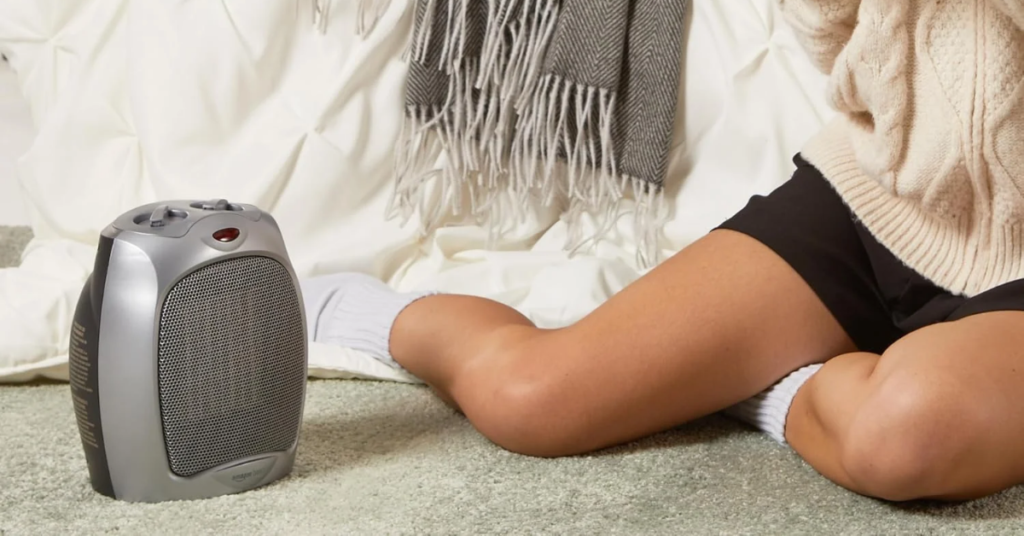
The Amazon Basics Ceramic Space Heater is worth considering if you prefer a straightforward heater without an unnecessarily complicated control system. Ceramic heaters are commonly used for supplemental indoor heating because they combine an electric heating element with a fan to distribute warm air.
The linked Amazon Basics model is listed with a 900W low setting and a 1,500W high setting. That makes it an option for people who want the flexibility to use less power when the room does not require maximum heat.
Key Features
- Adjustable heat output: The listed version offers 900W and 1,500W heating levels.
- Ceramic heating technology: Uses an electric ceramic element to produce warm air.
- Compact format: Designed to provide supplemental warmth without the size of a full room-heating appliance.
- Straightforward controls: Suitable for people who prefer simple operation over extensive customization.
- Safety considerations: Verify the exact model’s overheat protection, tip-over shutoff, and other safety specifications before purchasing.
Best For
Shoppers looking for a simple portable heater for a bedroom, home office, or other small indoor area. It may be particularly appealing if you want an uncomplicated design and a lower-power setting.
Things to Consider
- The 900W low setting is not as economical in electricity consumption as a 400W setting when both heaters run continuously.
- Confirm the wattage and safety features on the exact product listing because specifications can vary between heater models.
- A compact heater is primarily a supplemental heating solution and may struggle in a large or poorly insulated room.
How to Choose the Right Low-Wattage Heater for Small Rooms
Choosing the right heater involves more than comparing product prices. Wattage, room size, temperature control, safety, and how long you intend to run the heater can all affect your experience.
1. Compare Wattage and Heat Output
Wattage indicates how much electrical power a heater uses while operating at a particular setting.
For shoppers specifically seeking low-wattage heaters, these are useful reference points:
- 400W: Suitable for modest supplemental warmth in a personal area.
- 800W: Offers more heating power for small rooms and workspaces.
- 900W: A middle-ground option available on some conventional portable heaters.
- 1,500W: Provides higher heat output but consumes more electricity when operating continuously at maximum power.
A lower-wattage heater generally produces less heat at any given moment. It may be adequate for a small, insulated room but struggle to maintain a comfortable temperature in a cold, drafty space.
2. Consider Your Room Size
A compact personal heater is not necessarily suitable for heating an entire bedroom.
Before purchasing, consider the room’s floor area, ceiling height, insulation, windows, and outdoor temperature. A small, well-insulated office may need less supplemental heat than a larger bedroom with drafty windows.
If you mainly want to keep your hands and feet warm while working, a low-wattage personal heater may be more appropriate than a powerful tower heater.
3. Look for Adjustable Power Settings
Adjustable heat settings allow you to use less power when maximum heat is unnecessary.
For example, the Teioe’s 400W setting uses less electricity per hour than the 900W setting available on the linked Lasko and Amazon Basics models.
However, the lowest setting is not automatically the best choice for every situation. If it cannot provide enough warmth, you may need to operate the heater longer or choose a different heating solution.
4. Check the Thermostat and Timer
A thermostat can switch the heating element on and off to help maintain a selected temperature. This can reduce energy consumption when the heater would otherwise run continuously.
A timer can help you avoid leaving a heater operating longer than intended.
Remember that neither feature guarantees a particular electricity saving. Actual consumption depends on room conditions, temperature settings, operating time, and the heater’s power level.
5. Prioritize Essential Safety Features
Portable electric heaters should be selected with safety in mind.
Look for suitable overheat protection, tip-over shutoff where applicable, and recognized independent safety certification for the exact model. Follow the manufacturer’s operating instructions.
Keep the heater at least three feet away from combustible materials where specified by safety guidance, place it on a stable surface, and plug it directly into an appropriate wall outlet. Never use an extension cord or power strip with a portable electric space heater.
Never leave a portable space heater operating while you sleep or when it is unattended. A timer or automatic shutoff is an additional safeguard, not a substitute for safe operation.
6. Calculate the Electricity Cost
You can estimate a heater’s electricity consumption using a simple formula:
Electricity consumed (kWh) = Wattage ÷ 1,000 × Hours of use
For example, if you operate a heater for five hours:
- 400W heater: 2 kWh
- 800W heater: 4 kWh
- 900W heater: 4.5 kWh
- 1,500W heater: 7.5 kWh
Multiply the energy consumed by your electricity rate to estimate the operating cost.
These figures assume the heater operates continuously at the stated wattage for all five hours. A thermostat-controlled heater that cycles on and off may consume less.
FAQs
1. What is the best low-wattage heater for a small room?
The Teioe Mini Electric Space Heater is a strong option to consider because it offers 400W and 800W settings. The lower setting is useful for modest supplemental warmth, while the higher setting provides more heat when needed.
2. Is a 400W heater enough to heat a small bedroom?
A 400W heater may provide supplemental warmth in a very small, well-insulated space, but it may not heat an entire bedroom adequately in cold conditions. Its effectiveness depends on room size, insulation, outdoor temperature, and your comfort needs.
3. Does a low-wattage heater use less electricity?
Yes, when comparing heaters operating continuously for the same amount of time, a lower-wattage heater consumes less electricity. For example, a 400W heater uses 0.4 kWh per hour, while a 1,500W heater uses 1.5 kWh per hour at maximum power.
4. Are ceramic heaters energy-efficient for small rooms?
Ceramic heaters can be practical for supplemental heating because they produce warm air quickly and are available in compact designs. However, electric resistance heaters generally convert electricity into heat at similar rates at the point of use. The main energy savings come from using an appropriate power setting, heating only the space you need, and avoiding unnecessary operating time.
5. Can I leave a portable space heater on overnight?
It is not recommended to leave a portable space heater operating while you sleep. Turn it off before going to bed, keep it away from combustible materials, and follow the manufacturer’s safety instructions.
Conclusion
The best low wattage heaters for small rooms depend on how much warmth you need and how much electricity you want to use. The Teioe stands out for its 400W and 800W settings, while the Lasko and Amazon Basics models offer 900W low settings for shoppers who need more heating power. Dreo is worth considering if adjustable comfort and convenient controls are priorities. The QQT model requires further wattage and safety verification before it can be confidently recommended for low-power heating.
Before choosing, compare actual wattage, room requirements, safety features, and expected operating costs. Selecting a heater that matches your space can help you stay comfortable without using more electricity than necessary.