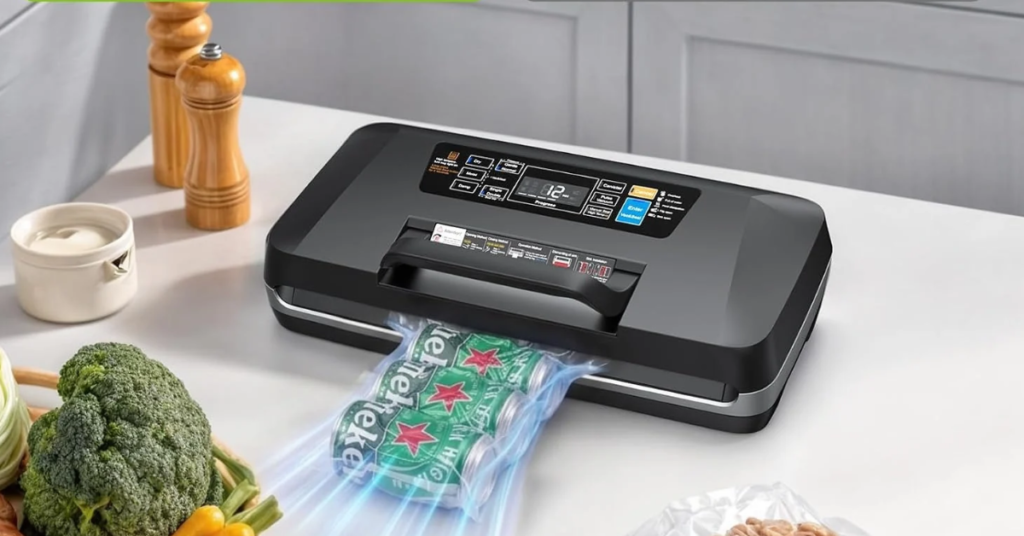
The best vacuum sealer for home food storage can help you organize groceries, portion meat, preserve leftovers, and prepare food for the freezer. By removing air from specially designed bags, a vacuum sealer can help reduce freezer burn and maintain food quality during storage. However, different models offer different advantages.
Some are designed for everyday meal preparation, while others provide more control or handle liquid-rich foods more effectively. This guide covers five vacuum sealers, highlighting their key features, practical uses, and important buying considerations to help you choose the right machine for your kitchen.
1. Avid Armor USV20 Chamber Vacuum Sealer — Best for Wet Foods and Bulk Preparation
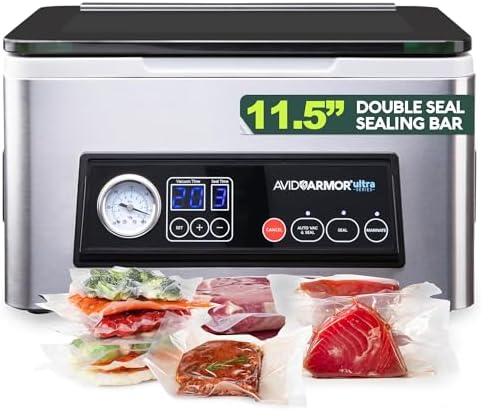
- Master Liquid Sealing Without Mess: Our chamber vacuum sealers with full-chamber pressure technology that equalizes vacu…
- Precision Vacuum & Seal Control: Dial in adjustable vacuum time (15 to 60 sec) and seal controls for consistent, repeata…
- Compact Footprint For Easy Storage: Sous vide vacuum sealer is designed with a space-saving 14″Wx12″Dx8.25″H body and 17…
The Avid Armor USV20 is a chamber-style vacuum sealer designed for home cooks who regularly prepare food in batches. Unlike conventional external vacuum sealers, which remove air through the opening of a bag, a chamber machine evacuates air from the chamber surrounding the pouch. This design makes it particularly useful for sealing foods containing liquids, such as marinades, sauces, and soups.
The USV20 also provides adjustable vacuum and sealing times, allowing you to tailor the process to different foods and pouch types. Its chamber design makes it a more specialized option than a typical countertop vacuum sealer.
Key Features
- Chamber vacuum technology: Suitable for sealing liquid-rich foods that can be difficult to package with conventional suction sealers.
- Adjustable controls: Vacuum time can be adjusted from 15 to 60 seconds, while sealing time has adjustable settings.
- Wide sealing bar: The 11.5-inch seal bar accommodates pouches up to 11 × 10 inches.
- Accessory connection: An included hose supports vacuum sealing compatible containers and canisters.
- Marinating function: Designed to help speed up the marinating process using vacuum pressure.
Best For
Home cooks who frequently seal marinated meat, portion soups and sauces, prepare freezer meals, or preserve larger quantities of food.
Things to Consider
- Its chamber design makes it larger and heavier than many conventional countertop sealers.
- It requires compatible chamber pouches rather than the textured bags commonly used with external suction machines.
- The higher level of control may be unnecessary if you only seal dry foods occasionally.
- Check the available counter space and lid clearance before purchasing.
2. Powerful Suction Vacuum Sealer — Best to Consider for Everyday Food Storage

- Durable & Sturdy Construction: Built with high-quality reinforced materials and precise manufacturing process, this hous…
- High Power Suction & Tight Heat Sealing: Adopting upgraded 230W motor and 95KPa ultra-strong suction technology, the vac…
- 10 Versatile Preset Working Modes: This all-purpose vacuum sealer is equipped with 10 practical working modes to meet di…
The second product in this guide is the vacuum sealer identified by the supplied Amazon listing as a powerful-suction, low-noise model with a removable design. It may be worth considering if your primary goal is to package groceries, prepare meal portions, and organize food for refrigerator or freezer storage.
For this particular listing, the full manufacturer specifications could not be independently verified. Therefore, it is important to confirm the exact model, sealing modes, bag compatibility, and included accessories before comparing it directly with established models.
Key Features
- Vacuum sealing: Designed to remove air from compatible food-storage bags before sealing.
- Low-noise positioning: The supplied listing highlights noise reduction, although the actual operating noise level has not been independently confirmed.
- Removable component or design: The listing references a removable feature; check the product details to determine exactly which part is removable and how it affects cleaning.
- Home food storage: The intended use makes it a potential candidate for routine food packaging and meal preparation.
Best For
Shoppers looking for a vacuum sealer for ordinary household food storage who want to investigate a model marketed around suction performance and convenient handling.
Things to Consider
- Verify the vacuum pressure or suction specification rather than relying solely on the phrase “powerful suction.”
- Check whether the machine supports dry and moist food settings.
- Confirm whether it uses standard textured vacuum-sealer bags or requires a specific bag type.
- Look for clear cleaning instructions, warranty information, and replacement-part availability.
3. Gasbye Vacuum Sealer — Best for Controlled Sealing

- [95kPa Powerful Suction + Pulse Mode Control] Use Auto Vac & Seal for one-touch everyday sealing—powerful 95kPa suction …
- [Double Heat Seal—Sous Vide Ready] Dual sealing strips create tight, consistent seals for dry and moist foods to help lo…
- [Built-in Storage & Bag Cutter—Less Waste] Integrated roll storage and a built-in cutter let you cut the exact bag size …
The Gasbye vacuum sealer listed in your product selection is worth considering if you want a dedicated machine for preparing food portions and packaging ingredients before refrigeration or freezing.
Gasbye offers different vacuum-sealer models, so the exact model number matters when comparing features. The supplied listing should be checked carefully to confirm its controls, sealing functions, and accessories rather than assuming that every Gasbye machine has the same specifications.
Key Features
- Vacuum packaging: Intended to remove air from compatible bags to support organized food storage.
- Controlled sealing: Check the exact listing for pulse operation or other manual controls that may help when packaging delicate foods.
- Household food preparation: A potential option for portioning meat, poultry, vegetables, and other ingredients.
- Practical storage workflow: Vacuum-packed portions can be labeled and organized by food type or preparation date.
Best For
Home cooks who regularly prepare ingredients in advance and want to compare a dedicated vacuum sealer with other countertop food-storage machines.
Things to Consider
- Confirm the exact model and available sealing modes before purchasing.
- If you plan to seal juicy meat or marinated food, check whether the machine has a moist-food setting and how it manages liquid near the sealing area.
- Verify whether a bag cutter, bag storage compartment, or accessory hose is included with this specific model.
- Compare the price of compatible bags and the warranty, not just the initial machine cost.
4. MEGAWISE Vacuum Sealer — Best for Compact Home Food Storage

- 80kpa Suction Power – Updated vacuum sealer uses a DC motor pump with electromagnetic perm and pure copper core to enhan…
- Works with more Food Types – Updated version has a Moist mode that removes liquids (as much as 10ml) from your meat or f…
- One-Touch Operation & Two Specialized Modes – So easy, quick and practical: One touch the Vac/Seal button, you can get t…
The MEGAWISE vacuum sealer is designed for people who want a practical machine for everyday food packaging without investing in a larger chamber system. Its compact format makes it a candidate for kitchens where countertop space is limited and food sealing is mainly part of routine meal preparation.
This model is worth considering for packaging individual portions, storing pantry ingredients, and preparing foods for freezing. Before purchasing, review the current product specifications to confirm its available operating modes and included accessories.
Key Features
- Compact design: A practical consideration for kitchens with limited storage or countertop space.
- Vacuum sealing function: Designed to remove air from compatible bags before sealing them.
- Starter kit positioning: The supplied product listing identifies it as a starter-kit package; check the current listing to confirm which bags and accessories are included.
- Everyday versatility: Suitable for shoppers who want to explore vacuum sealing for portion control, meal preparation, and household food storage.
Best For
Beginners who want to start vacuum sealing food at home, particularly those who plan to store meat portions, vegetables, dry ingredients, and leftovers.
Things to Consider
- Confirm whether the model supports separate dry and moist food settings.
- Check the maximum bag width to ensure it accommodates your usual portions.
- Review the included accessories before purchasing additional bags or rolls.
- If you frequently seal large quantities of food, consider whether a compact machine will meet your workload.
5. FRESKO Compact V2 Automatic Vacuum Sealer — Best for Convenient Food Preparation
Amazon Link: https://www.amazon.com/FRESKO-Compact-V2-Automatic-Detection/dp/B0DQ7K9HHB/
The FRESKO Compact V2 is an option for shoppers who prefer a straightforward vacuum-sealing process. Its automatic operating approach is intended to make food packaging easier for routine household use.
Automatic vacuum sealers can be especially useful when preparing several food portions at once. However, the exact functions available depend on the model, so it is important to distinguish the Compact V2 from other FRESKO machines with different specifications.
Key Features
- Automatic sealing operation: Designed to simplify the process of removing air and sealing compatible food bags.
- Compact format: May suit households looking for a countertop machine without the footprint of a chamber vacuum sealer.
- Household food storage: Useful for organizing portions of meat, vegetables, dry foods, and other suitable ingredients.
- Model-specific controls: Check the current product information to confirm whether the Compact V2 includes automatic moisture detection, dedicated food modes, or a removable drip tray.
Best For
Home cooks who prioritize convenience and want a vacuum sealer for regular meal preparation, grocery storage, and freezer organization.
Things to Consider
- Confirm the exact model number because FRESKO sells vacuum sealers with different features.
- Check whether the machine can adjust its operation for moist foods.
- Review cleaning instructions, particularly if the model includes a removable drip tray.
- Compare bag compatibility and the cost of replacement supplies before making your final decision.
How to Choose the Right Vacuum Sealer for Home Food Storage
Choosing a vacuum sealer becomes easier when you focus on the types of food you store, how often you use the machine, and the amount of control you need.
1. Choose Between Chamber and External Vacuum Sealers
External vacuum sealers remove air through the opening of a bag. They are often suitable for everyday food storage, portioning meat, packaging dry ingredients, and preparing freezer meals.
Chamber vacuum sealers remove air from an enclosed chamber containing the bag. This design makes them particularly useful for liquids, sauces, marinades, and other foods that may be drawn toward the suction opening of an external machine.
The Avid Armor USV20 is the chamber-style option among the five products covered here. The other models should be checked individually to confirm their designs.
2. Consider Dry and Moist Food Settings
Not all foods behave the same way during vacuum sealing.
Dry ingredients such as nuts, grains, and coffee are generally straightforward to package. Moist foods, including fresh meat and marinated ingredients, require more care because liquid can interfere with the sealing process.
If you frequently package moist foods, look for a machine with a dedicated moist setting, adjustable vacuum control, or a chamber design. These features can make food preparation easier, although the correct method still depends on the food and machine.
3. Check Bag Compatibility
Vacuum sealers do not all use the same type of bags.
Many external machines require textured vacuum-sealer bags or rolls that allow air to escape during suction. Chamber machines generally use smooth chamber pouches.
Before buying, check the compatible bag type, maximum bag width, and availability of replacement supplies. These details can affect both convenience and long-term operating costs.
4. Look at Sealing Controls
Basic machines may use automatic vacuum-and-seal cycles, while other models offer additional controls.
Useful features may include:
- Automatic operation: Reduces the number of steps required to seal a bag.
- Pulse control: Allows more careful control when handling delicate foods, if supported.
- Moist food mode: Adjusts the sealing process for foods with higher moisture content.
- Adjustable sealing time: Provides more control over the seal when different bag materials or food portions require it.
Choose the features that match your actual needs rather than paying for controls you are unlikely to use.
5. Evaluate Cleaning and Storage
Food particles and liquid residue can collect around the sealing area. A removable drip tray, where available, can make cleaning easier.
Also consider the machine’s overall dimensions, storage requirements, and ease of handling. A larger chamber sealer may be useful for frequent bulk preparation, while a compact external model may be more practical for occasional use.
6. Compare Long-Term Value
The initial purchase price is only one part of the total cost.
Consider the price of compatible bags, the number of portions you expect to seal, the machine’s warranty, and the availability of replacement parts. If you regularly buy food in bulk or prepare meals ahead of time, vacuum sealing may help reduce freezer burn and food waste when combined with appropriate storage practices.
However, vacuum sealing does not make food shelf-stable by itself. Perishable foods still require proper refrigeration or freezing.
FAQs
1. What is the best vacuum sealer for home food storage?
The best option depends on your food-storage habits. The Avid Armor USV20 is worth considering if you frequently seal liquids and marinades. For ordinary household food packaging, compare the other models based on their controls, bag compatibility, cleaning requirements, and size.
2. Does vacuum sealing keep food fresh longer?
Vacuum sealing removes much of the air surrounding food, which can help maintain quality and reduce freezer burn. However, it does not prevent every form of spoilage or eliminate harmful microorganisms. Appropriate refrigeration, freezing, and food-handling practices remain essential.
3. Can you vacuum seal meat for the freezer?
Yes. Vacuum sealing can help protect meat from freezer burn and reduce exposure to air during storage. Divide meat into suitable portions, use compatible bags, label each package with the food name and date, and freeze it promptly.
4. Are chamber vacuum sealers better than regular vacuum sealers?
Chamber vacuum sealers have an advantage when packaging liquids and liquid-rich foods. External sealers are often smaller and simpler for everyday food storage. Neither design is automatically better for every household; the right choice depends on your intended use.
5. Can vacuum sealers be used for vegetables and leftovers?
Yes, but preparation matters. Some vegetables require blanching before freezing to help maintain quality. Allow cooked food to cool safely and refrigerate or freeze it promptly. Use suitable containers or bags and follow the manufacturer’s instructions for foods that may be crushed by strong suction.
Conclusion
The best vacuum sealer for home food storage should match your kitchen routine, preferred foods, and available storage space. The Avid Armor USV20 stands out as a chamber-style option to investigate for liquid-rich foods and bulk preparation, while the MEGAWISE and FRESKO models may appeal to shoppers looking for convenient household food packaging. The Gasbye and powerful-suction models also deserve consideration, provided their exact specifications meet your requirements.
Before purchasing, verify the model, sealing modes, bag compatibility, cleaning features, and long-term supply costs. With the right machine and proper food-storage practices, vacuum sealing can make meal preparation and freezer organization more manageable.