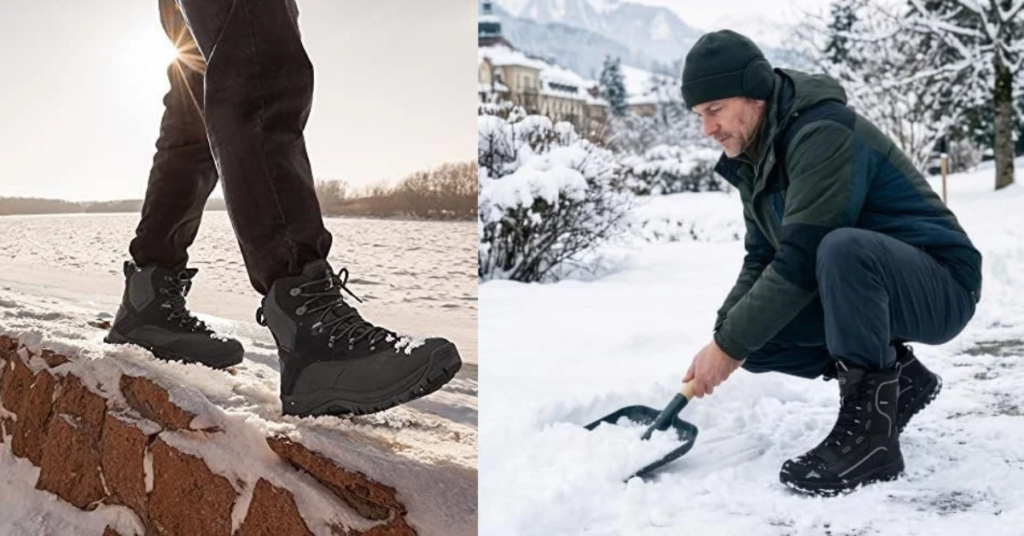
The best waterproof winter boots for walking on snow should keep your feet dry, retain warmth in cold weather, and provide dependable traction on slippery winter surfaces. Whether you are walking to work, clearing snow, hiking outdoors, or running everyday errands, choosing the right pair can make a noticeable difference in comfort and stability.
In this guide, we compare five winter boots from NORTIV 8, GUBARUN, COOJOY, and ROCKMARK. We cover their key features, intended uses, and important considerations to help you choose boots that suit your winter conditions and walking needs.
1. NORTIV 8 Men’s Tall Waterproof Snow Boots — Best for Deep Snow

NORTIV 8 Quebec Men’s Tall Snow Boots are designed for cold-weather activities where additional coverage around the lower legs can be useful. Compared with ankle-height winter boots, their taller design helps protect against snow entering around the boot opening during outdoor walks.
The boots combine insulated construction with a waterproof upper and a rugged outsole. Their adjustable closure system also makes them practical for people who want to put on or remove their boots without dealing with traditional laces.
Key Features
- Tall boot design: Provides more lower-leg coverage than ankle-height winter boots, making it useful when walking through deeper snow.
- Waterproof construction: The manufacturer describes the upper as waterproof, with protection intended for wet winter conditions.
- Insulated interior: The boots feature approximately 200 grams of insulation and a warm faux-fur lining to help retain heat.
- Adjustable closure: A drawstring and hook-and-loop ankle strap help secure the fit and make the boots easier to put on and take off.
- Textured outsole: The 5 mm TPR outsole is designed to provide traction on outdoor surfaces.
Best For
People who frequently walk through snowy outdoor areas and prefer taller boots for additional coverage. They are also worth considering for winter chores, outdoor recreation, and everyday use in cold weather.
Things to Consider
- The taller design may feel bulkier than an ankle-height boot during long walks on cleared sidewalks.
- Waterproof protection has limits, so avoid submerging the boots beyond their specified waterproof depth.
- Although the outsole is designed for traction, icy surfaces can still be slippery. Consider additional traction aids when walking on hard ice.
2. NORTIV 8 Men’s 180411 Insulated Waterproof Snow Boots — Best for Everyday Winter Walking

The NORTIV 8 180411 is a practical option for people who want insulated winter footwear for regular outdoor use. Its ankle-height design offers a different experience from taller snow boots, making it worth considering for daily walks, commuting, and outdoor chores.
One of its main features is the combination of insulation, waterproof construction, and a removable insole. This combination is useful for people who want cold-weather protection without choosing a taller boot.
Key Features
- Waterproof construction: Designed to help keep feet dry during ordinary winter activities involving snow and wet conditions.
- 200 g insulation: The manufacturer specifies 200 g of insulation and advertises warmth in temperatures as low as -25°F under its stated conditions.
- Removable insole: The cushioned insole can be removed for cleaning or drying.
- Slip-resistant rubber outsole: The outsole is designed to improve grip and resist abrasion across different outdoor surfaces.
- Protective toe area: The synthetic toe cap adds protection against bumps during outdoor activities.
Best For
People who need waterproof winter boots for daily walks, commuting, snow clearing, and general outdoor activities. The ankle-height construction may also appeal to shoppers who prefer a less bulky alternative to tall snow boots.
Things to Consider
- Ankle-height boots provide less protection against deep snow entering over the top than taller designs.
- The advertised temperature rating should not be treated as a guarantee of comfort for every wearer. Socks, activity level, fit, wind, and exposure time all affect warmth.
- Check the manufacturer’s sizing chart, especially if you plan to wear thick winter socks.
3. COOJOY Women’s Waterproof Winter Snow Boots — Best for Women’s Everyday Winter Wear

COOJOY Women’s Waterproof Winter Snow Boots are designed for women who want a combination of winter warmth and everyday styling. The supplied listing identifies the product as a waterproof winter boot with a soft faux-fur lining.
The lace-up design allows the fit to be adjusted around the foot, while the padded interior is intended to provide warmth and cushioning. Their casual appearance may also make them suitable for everyday outfits during cold weather.
Key Features
- Waterproof upper: The product listing describes an upper made with waterproof Oxford cloth and PU leather to help protect against wet conditions.
- Faux-fur lining: The soft lining is designed to provide warmth and a comfortable feel during winter wear.
- Lace-up closure: Allows you to adjust the fit around your foot and ankle.
- Rubber outsole: The rubber sole is designed for outdoor walking and everyday use.
- Casual styling: The boot design can pair with jeans and other everyday winter clothing.
Best For
Women looking for winter boots for everyday walking, casual outings, dog walking, and ordinary snowy or rainy conditions.
Things to Consider
- Confirm the exact boot height and available sizes before purchasing, as product variations may differ.
- These boots should not automatically be considered suitable for prolonged hiking or extremely cold conditions without confirming their insulation and construction details.
- Waterproof uppers cannot prevent snow or water from entering through the opening if it rises above the protected area.
4. GUBARUN Waterproof Outdoor Winter Boots — Best for Casual Outdoor Use
Amazon Link: https://www.amazon.com/GUBARUN-Boots-Outdoor-Waterproof-Black1/dp/B07DKJH4DF/
GUBARUN is another option to investigate when comparing waterproof winter footwear for everyday outdoor activities. The supplied product listing identifies these as outdoor boots, but detailed specifications for the exact model could not be independently confirmed.
Before choosing this pair, focus on the current listing’s construction details, lining, outsole design, and fit information. These details matter more for snowy walks than appearance alone.
Key Features
- Outdoor boot design: Intended for outdoor use, making the product worth comparing with other casual winter footwear.
- Waterproof claim: Verify the exact listing’s waterproof construction details before relying on the boots for prolonged exposure to wet snow.
- Outsole traction: Review the tread pattern and sole material to determine whether they suit your typical walking surfaces.
- Fit and insulation: Check the current product information for lining material, available sizes, and the amount of insulation.
Best For
Shoppers considering an outdoor boot for everyday winter use who want to compare its fit, insulation, waterproofing, and price with more fully documented alternatives.
Things to Consider
- Confirm whether the product offers full waterproof construction or only water-resistant materials.
- Check the boot height to determine how well it suits the depth of snow you usually encounter.
- Do not assume that the outsole is suitable for ice simply because the listing describes it as non-slip.
5. ROCKMARK Men’s Waterproof Winter Snow Boots — Best for Outdoor Winter Activities
Amazon Link: https://www.amazon.com/ROCKMARK-Outdoor-Waterproof-Non-Slip-Climbing/dp/B07Y3YJFC7/
ROCKMARK Men’s Winter Snow Boots are worth considering for shoppers who prefer a rugged boot for outdoor use. The supplied product listing identifies them as waterproof winter boots designed for cold-weather activities.
The model is marketed with a combination of insulated lining, a lace-up fit, and an outsole intended to provide traction. These features are relevant for people who spend time outdoors during winter, although the exact level of performance depends on the boot’s construction and the conditions in which it is used.
Key Features
- Waterproof design: Intended to help protect feet from wet winter conditions. Check the current listing for details about the waterproof materials and construction.
- Warm lining: The product is described as having a warm interior intended for cold-weather wear.
- Lace-up closure: Helps secure the boots and adjust the fit around the foot.
- Rubber outsole: Designed for outdoor use on varied surfaces.
- Outdoor-oriented construction: The product is positioned for winter activities rather than exclusively for indoor or casual wear.
Best For
People comparing rugged winter boots for outdoor walks, everyday cold-weather use, and general winter recreation.
Things to Consider
- Verify the boot height, insulation details, and waterproof specifications for the exact model before purchasing.
- A rugged outsole can help on loose snow and uneven ground, but it does not guarantee safe footing on smooth ice.
- Make sure there is enough room for winter socks without making the boots loose around the heel.
How to Choose the Right Waterproof Winter Boots for Walking on Snow
Choosing winter boots involves more than finding a pair labelled waterproof. The right combination of waterproofing, insulation, traction, and fit will depend on your local weather and the type of walking you do.
1. Check the Waterproof Construction
Waterproof boots are designed to prevent water from passing through the protected upper and construction. However, protection can vary between models.
If you regularly walk through wet snow or slush, look for clearly documented waterproof materials and construction. Also consider the height of the boot, because water and snow can enter through the opening even when the lower portion is waterproof.
Water-resistant footwear may be suitable for occasional light moisture, but it should not automatically be treated as equivalent to fully waterproof footwear.
2. Choose the Right Insulation
Insulation helps reduce heat loss in cold conditions. Some boots specify insulation by weight, such as 200 g, while others emphasize their lining materials.
For short walks and everyday errands, moderate insulation may be sufficient in many climates. Longer walks in freezing temperatures may require warmer boots and suitable winter socks.
Remember that temperature ratings are manufacturer claims, not universal guarantees. Your comfort will depend on your activity level, circulation, socks, fit, and exposure to wind and moisture.
3. Look for Suitable Outsole Traction
Walking on snow requires an outsole that can grip loose, uneven surfaces. A rubber outsole with a pronounced tread pattern may help provide traction during outdoor use.
However, waterproofing and slip resistance do not guarantee safety on ice. Smooth, compacted ice can be slippery even when boots have deep tread. If you regularly encounter icy paths, consider compatible traction aids and walk slowly with shorter steps.
4. Decide Between Tall and Ankle-Height Boots
Boot height affects coverage, mobility, and convenience.
- Tall boots: Useful when walking through deeper snow because they provide additional coverage around the lower legs.
- Ankle-height boots: Often more convenient for daily commuting, cleared sidewalks, and routine outdoor chores.
- Mid-height boots: Can offer a balance between coverage and ease of movement, depending on the design.
Choose a height that matches the depth of snow you typically encounter rather than assuming that taller boots are always better.
5. Prioritize Comfort and Fit
Winter boots should fit comfortably with the socks you intend to wear. Your toes need enough room to move, while the heel should remain secure during walking.
Boots that are too tight can reduce comfort and may make it harder to keep your feet warm. Excessively loose boots can cause friction and reduce walking stability.
Check the size chart, width options, return policy, and customer feedback about sizing before ordering.
6. Consider Weight and Walking Duration
A heavily insulated boot may be useful in severe cold, but extra bulk can become tiring during longer walks. Lighter boots may be more comfortable for daily errands, provided they offer adequate warmth and protection for your climate.
Think about how long you will wear the boots, whether you will walk on cleared paths or uneven trails, and how much snow coverage you need.
7. Compare Overall Value
Instead of comparing prices alone, consider what each pair offers for your intended use.
Look at the quality of the waterproof construction, insulation, outsole, boot height, removable insoles, and available sizing. A boot that suits your environment and fits properly may be more useful than a cheaper option that lacks the coverage or warmth you need.
FAQs
1. What are the best waterproof winter boots for walking on snow?
The best choice depends on snow depth, temperature, and walking conditions. The NORTIV 8 Quebec is worth considering for its taller design, while the NORTIV 8 180411 offers an ankle-height alternative with insulation and a removable insole. Compare the remaining options based on their verified construction and fit.
2. Are waterproof winter boots good for walking on ice?
Waterproofing helps keep water out, but it does not necessarily improve grip on ice. Look for an outsole designed for traction and consider traction aids for icy conditions. Even boots marketed as slip-resistant cannot eliminate the risk of slipping on smooth ice.
3. Should winter walking boots be tight or loose?
Winter boots should fit securely without squeezing your toes. Leave enough room for the socks you plan to wear, and check that your heel does not slip excessively. A comfortable fit helps support warmth and walking stability.
4. Are tall snow boots better than ankle-height boots?
Tall boots generally provide more protection against snow entering around the opening, making them useful in deeper snow. Ankle-height boots can be more convenient for everyday walking on cleared paths. The better option depends on the conditions you encounter most often.
5. How can I keep my feet warm and dry while walking in snow?
Choose boots with suitable insulation, verified waterproof construction, and enough room for comfortable winter socks. Avoid allowing snow to enter through the opening, and dry your boots thoroughly after use according to the manufacturer’s care instructions.
Conclusion
The best waterproof winter boots for walking on snow should match your climate, walking habits, and comfort requirements. The NORTIV 8 Quebec stands out for shoppers who prefer a taller boot, while the NORTIV 8 180411 offers a more compact design with insulated construction and a removable insole. COOJOY provides a women’s everyday option, while GUBARUN and ROCKMARK are alternatives to investigate after verifying their exact product specifications.
Before choosing, prioritize waterproof protection, appropriate insulation, reliable traction, and a comfortable fit. If you regularly walk on ice, remember that no ordinary winter boot can guarantee slip-free footing.